

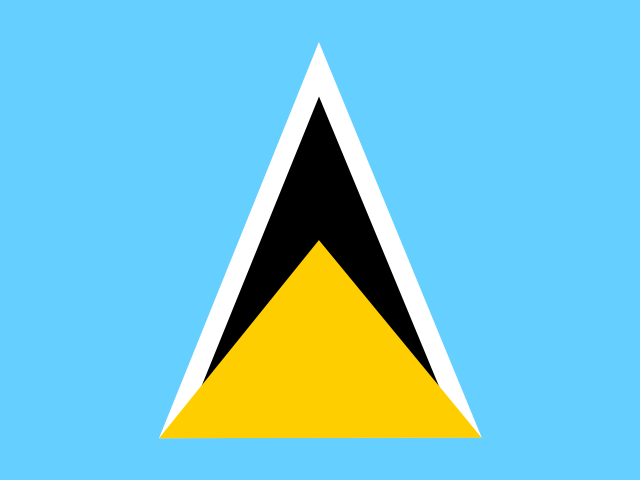
St. Lucia
Population
Area
GDP
GDP Per Capita
Quick FAQs
Region
Capital
ISO 3166
Government Type
Language
ON THIS PAGE
About St. Lucia
Saint Lucia is a country located in the Caribbean between the Caribbean Sea and North Atlantic Ocean, north of Trinidad and Tobago, covering an area of approximately 616 square kilometers. As of 2025, Saint Lucia has a population of about 168,462, with English as the official language alongside Saint Lucian Creole. The island is volcanic and mountainous with broad, fertile valleys, with a tropical climate moderated by northeast trade winds and a dry season from January to April. Castries serves as the capital, and the government operates as a parliamentary democracy under a constitutional monarchy.
Saint Lucia has an upper-middle-income, tourism-based Caribbean island economy with a GDP of $2.55 billion and a GDP per capita of $24,300, driven by tourism, clothing, assembly of electronic components, beverages, corrugated cardboard boxes, lime processing, and coconut processing. Key agricultural products include coconuts, bananas, tropical fruits, root vegetables, plantains, vegetables, cassava, chicken, and milk, while natural resources include forests, sandy beaches, minerals, mineral springs, and geothermal potential. The unemployment rate is 11% as of 2024. Saint Lucia is environmentally fragile and energy import-dependent, though it has a well-educated labor force and is making key infrastructure, IT, and communications investments.
Geography & Environment
Geographic Location
Geographic Coordinate
Geographic Area
Climate
Terrain
Natural Hazards
Natural Resources
Geography Note
People & Society
Ave. Life Expentancy at Birth
Urbanization
Population Growth Rate
Literacy Rate
Health Expendeture
Education Expenditure
Languages
Religions
Government
Country Name
conventional short form: Saint Lucia
etymology: believed to be named after Saint LUCY (Sainte ALOUSIE) of Syracuse by French sailors who were shipwrecked on the island on 13 December 1502, the saint's feast day
Economy
Economic Overview
upper middle-income, tourism-based Caribbean island economy; environmentally fragile; energy import-dependent; major banana producer; well-educated labor force; key infrastructure, IT, and communications investments