

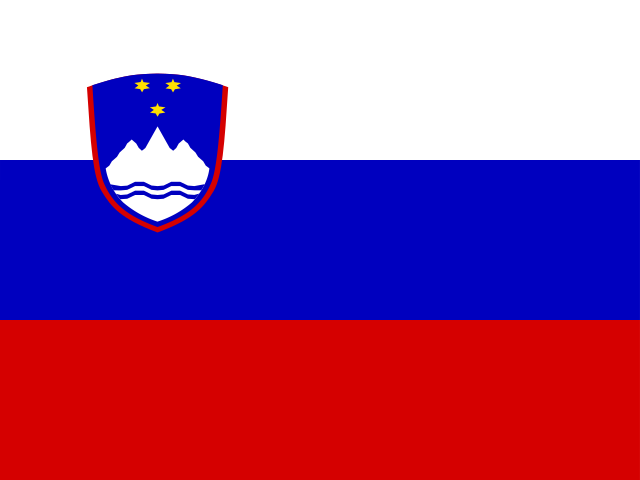
Slovenia
Population
Area
GDP
GDP Per Capita
Quick FAQs
Region
Capital
ISO 3166
Government Type
Language
ON THIS PAGE
About Slovenia
Slovenia is a country located in south Central Europe in the Julian Alps between Austria and Croatia, covering an area of approximately 20,273 square kilometers. As of 2024, Slovenia has a population of about 2.1 million, with Slovene as the official language alongside Croatian, Bosnian, Serbian, and Hungarian. The country features a short southwestern coastal strip of Karst topography on the Adriatic, an alpine mountain region adjacent to Italy and Austria, and mixed mountains and valleys to the east, with a Mediterranean climate on the coast and a continental climate in the plateaus and valleys. Ljubljana serves as the capital, and the government operates as a parliamentary republic.
Slovenia has a high-income EU and eurozone economy with a GDP of $72.48 billion and a GDP per capita of $48,500, driven by ferrous metallurgy and aluminum products, lead and zinc smelting, electronics, trucks, automobiles, electric power equipment, wood products, textiles, chemicals, and machine tools. Key agricultural products include milk, maize, wheat, barley, grapes, chicken, potatoes, beef, apples, and pork, while natural resources include lignite, lead, zinc, building stone, hydropower, and forests. The unemployment rate is 3.2% as of 2025, with a life expectancy of 82.3 years. Slovenia has high per-capita income and low inequality, with key exports in automotive and pharmaceuticals and a tight labor market with low unemployment.
Geography & Environment
Geographic Location
Geographic Coordinate
Geographic Area
Climate
Terrain
Natural Hazards
Natural Resources
Geography Note
People & Society
Ave. Life Expentancy at Birth
Urbanization
Population Growth Rate
Literacy Rate
Health Expendeture
Education Expenditure
Languages
Religions
Government
Country Name
conventional long form
conventional short form
local long form
local short form
former
etymology
Economy
Economic Overview
high-income EU and eurozone economy; high per-capita income and low inequality; key exports in automotive and pharmaceuticals; tight labor market with low unemployment; growth supported by private consumption and public investment, with risks from tight labor market and trade conditions; narrowing fiscal deficit and declining public debt