

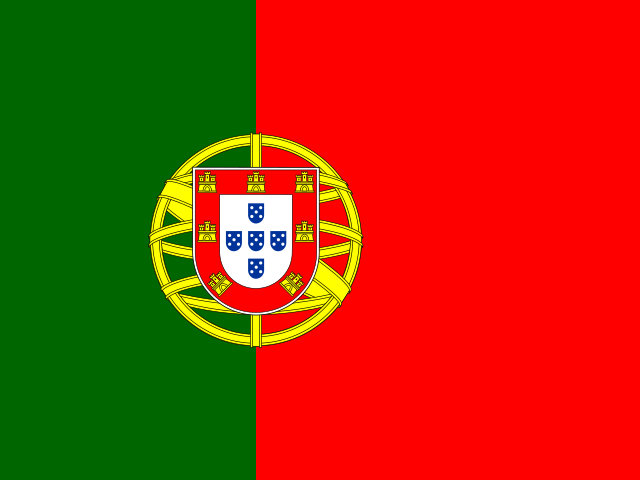
Portugal
Population
Area
GDP
GDP Per Capita
Quick FAQs
Region
Capital
ISO 3166
Government Type
Language
ON THIS PAGE
About Portugal
Portugal is a country located in Southwestern Europe bordering the North Atlantic Ocean, west of Spain, covering an area of approximately 92,090 square kilometers. As of 2025, Portugal has a population of about 10.19 million, with Portuguese as the official language alongside Mirandese. The Tagus River divides the country, with the north being mountainous toward the interior and the south characterized by rolling plains, featuring a maritime temperate climate that is cool and rainy in the north and warmer and drier in the south. Lisbon serves as the capital, and the government operates as a semi-presidential republic.
Portugal has a high-income EU and eurozone economy with a GDP of $308.68 billion and a GDP per capita of $41,900, driven by textiles, clothing, footwear, wood and cork, paper and pulp, chemicals, automobiles and auto parts, base metals, minerals, porcelain and ceramics, glassware, technology, telecommunications, tourism, and financial services. Key agricultural products include milk, tomatoes, olives, grapes, maize, pork, potatoes, chicken, apples, and oranges, while natural resources include fish, forests, iron ore, copper, zinc, tin, tungsten, silver, gold, uranium, marble, clay, gypsum, salt, arable land, and hydropower. The unemployment rate is 6.2% as of 2025, with a life expectancy of 82.4 years. Portugal has a strong services sector led by tourism and banking, with a tight labor market and declining public debt.
Geography & Environment
Geographic Location
Geographic Coordinate
Geographic Area
Climate
Terrain
Natural Hazards
Natural Resources
Geography Note
People & Society
Ave. Life Expentancy at Birth
Urbanization
Population Growth Rate
Literacy Rate
Health Expendeture
Education Expenditure
Languages
Religions
Government
Country Name
conventional short form: Portugal
local long form: Republica Portuguesa
local short form: Portugal
etymology: name derives from the Roman designation "Portus Cale," meaning "Port of Cale;" Cale was located in present-day northern Portugal, and its name is said to come from the Latin word calere (to be warm) because the harbor never iced over
Economy
Economic Overview
high-income EU and eurozone economy; strong services sector led by tourism and banking; tight labor market; growth driven by private consumption, trade surplus, and public investment from EU funds; declining public debt