

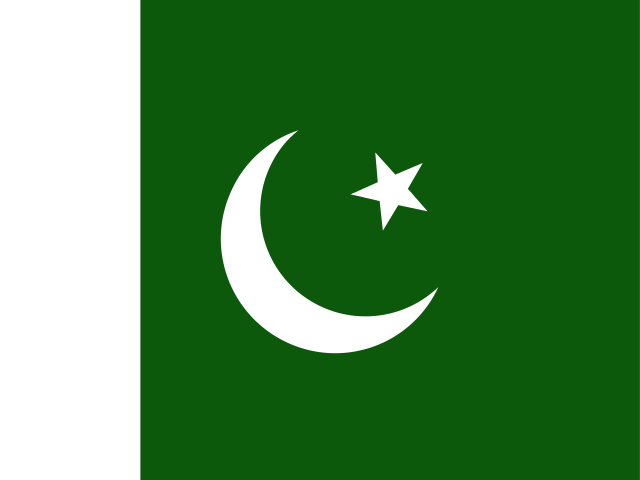
Pakistan

Asia
Islamabad

Population

257.05M

Area

796,095 km²

GDP

$373.07B

GDP Per Capita

$5,500

Quick FAQs

Region

Asia

Capital

Islamabad

ISO 3166

pk

Government Type

federal parliamentary republic

Language

Punjabi 38.8%, Pashto (alternate name, Pashtu) Learn more

ON THIS PAGE

About Pakistan

Pakistan is a country located in Southern Asia bordering the Arabian Sea, between India on the east and Iran and Afghanistan on the west and China in the north, covering an area of approximately 796,095 square kilometers. As of 2025, Pakistan has a population of about 257 million, with Punjabi, Pashto, Sindhi, Saraiki, Urdu, Balochi, Hindko, and Brahui as major languages. The country is divided into three major geographic areas including the northern highlands, the Indus River plain in the center and east, and the Balochistan Plateau in the south and west, with a mostly hot, dry desert climate that is temperate in the northwest and arctic in the north. Islamabad serves as the capital, and the government operates as a federal parliamentary republic.

Pakistan has a lower-middle-income economy with a GDP of $373.07 billion and a GDP per capita of $5,500, driven by textiles and apparel, food processing, pharmaceuticals, surgical instruments, construction materials, paper products, fertilizer, and shrimp. Key agricultural products include sugarcane, bison milk, wheat, milk, rice, maize, potatoes, cotton, mangoes and guavas, and chicken, while natural resources include arable land, extensive natural gas reserves, limited petroleum, poor quality coal, iron ore, copper, salt, and limestone. The unemployment rate is 5.4% as of 2025, with a life expectancy of 67.8 years and a literacy rate of 58.9%. Pakistan faces extremely high debt and endemic corruption, though falling inflation, IMF relief programs, and strong agricultural output are slowly contributing to economic recovery.

Geography & Environment

Geographic Location

Southern Asia, bordering the Arabian Sea, between India on the east and Iran and Afghanistan on the west and China in the north

Geographic Coordinate

30 00 N, 70 00 E

Geographic Area

796,095 km²

Climate

mostly hot, dry desert; temperate in northwest; arctic in north

Terrain

divided into three major geographic areas: the northern highlands, the Indus River plain in the center and east, and the Balochistan Plateau in the south and west

Natural Hazards

frequent earthquakes, occasionally severe especially in north and west; flooding along the Indus after heavy rains (July and August)

Natural Resources

arable land, extensive natural gas reserves, limited petroleum, poor quality coal, iron ore, copper, salt, limestone

Geography Note

controls Khyber Pass and Bolan Pass, traditional invasion routes between Central Asia and India

People & Society

Ave. Life Expentancy at Birth

67.8 years

Urbanization

38%

Population Growth Rate

1.82% (2025 est.)

Literacy Rate

N/A

Health Expendeture

N/A

Education Expenditure

N/A

Languages

Punjabi 38.8%, Pashto (alternate name, Pashtu) 18.2%, Sindhi 14.6%, Saraiki (a Punjabi variant) 12.2%, Urdu 7.1%, Balochi 3%, Hindko 2.4%, Brahui 1.2%, other 2.4%

Religions

Muslim 96.4%, Hindu 1.6%, Christian 1.4%; less than 1%: scheduled castes, Qadiani/Ahmadi, other, Sikh. (2020 est.)

Government

Country Name

conventional long form

Islamic Republic of Pakistan

conventional short form

Pakistan

local long form

Jamhuryat Islami Pakistan

local short form

Pakistan

former

West Pakistan

etymology

the name is said to have been proposed in the early 1930s by Muslim students at Cambridge University, created from the initials of Punjab, Afghanistan, and Kashmir; the word pak also means "pure" in Persian or Pashto, and the Persian suffix -stan means "place of" or "country," so Pakistan literally means "Land of the Pure"

Economy

Economic Overview

lower middle-income South Asian economy; extremely high debt; endemic corruption; regional disputes with India and Afghanistan hinder investment; falling inflation, IMF relief programs, and strong agricultural output slowly contributing to economic recovery

GDP Per Capita

$5,500

Unemployment Rate

N/A

Population Below Poverty Line

21.9% (2018 est.)

Industries

textiles and apparel, food processing, pharmaceuticals, surgical instruments, construction materials, paper products, fertilizer, shrimp

Agricultural Products

sugarcane, bison milk, wheat, milk, rice, maize, potatoes, cotton, mangoes/guavas, chicken (2023)

Location

Organizations Making an Impact in Pakistan

Discover the passionate teams and non-profits currently driving progress in this space
Find Nonprofits
0 nonprofit found (0 total)
Sorry. We have no Nonprofits for this country yet.
Load More Organizations

Give Your Mission a Global Stage

Join thousands of nonprofits on Missions for Good. Expand your digital footprint, share your story, and connect directly with passionate donors who are searching for causes just like yours.

Let’s Scale Your Impact Together.

Have a question about your Digital Marketing, SEO and Google Ad Grant?
Schedule a Strategic Call

Close Form