

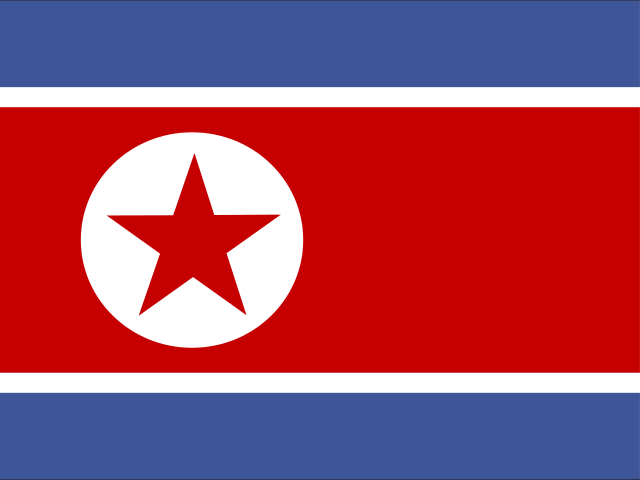
North Korea
Population
Area
GDP
GDP Per Capita
Quick FAQs
Region
Capital
ISO 3166
Government Type
Language
ON THIS PAGE
About North Korea
North Korea is a country located in Eastern Asia on the northern half of the Korean Peninsula, bordering the Korea Bay and the Sea of Japan, between China and South Korea, covering an area of approximately 120,538 square kilometers. As of 2025, North Korea has a population of about 26.4 million, with Korean as the official language. The country is mostly hills and mountains separated by deep, narrow valleys with wide coastal plains in the west, and has a temperate climate with rainfall concentrated in summer and long, bitter winters. Pyongyang serves as the capital, and the government operates as a dictatorship and single-party communist state.
North Korea has one of the last centrally planned economies with a GDP of $16.45 billion and a GDP per capita of just $600, with industries including military products, machine building, electric power, chemicals, mining, metallurgy, textiles, food processing, and tourism. Key agricultural products include rice, maize, potatoes, vegetables, apples, pork, chicken, eggs, cabbages, and milk, while natural resources include coal, iron ore, limestone, magnesite, graphite, copper, zinc, lead, precious metals, and hydropower. The economy has been hard hit by COVID-19, crop failures, international sanctions, and isolationist policies, with declining growth and heavy reliance on China.
Geography & Environment
Geographic Location
Geographic Coordinate
Geographic Area
Climate
Terrain
Natural Hazards
Natural Resources
Geography Note
People & Society
Ave. Life Expentancy at Birth
Urbanization
Population Growth Rate
Literacy Rate
Health Expendeture
Education Expenditure
Languages
Religions
Government
Country Name
conventional long form
conventional short form
local long form
local short form
abbreviation
etymology
Economy
Economic Overview
one of the last centrally planned economies; hard hit by COVID-19, crop failures, international sanctions, and isolationist policies; declining growth and trade, and heavily reliant on China; poor exchange rate stability; economic data integrity issues