

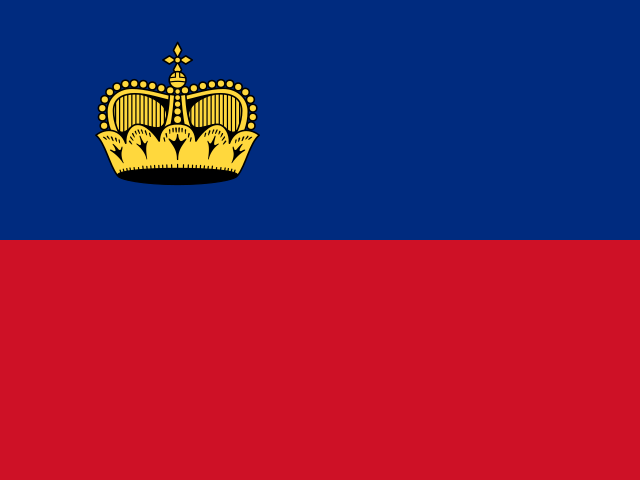
Liechtenstein
Population
Area
GDP
GDP Per Capita
Quick FAQs
Region
Capital
ISO 3166
Government Type
Language
ON THIS PAGE
About Liechtenstein
Liechtenstein is a principality located in Central Europe, between Austria and Switzerland, covering an area of approximately 160 square kilometers. As of 2025, Liechtenstein has a population of about 40,500, with German as the official language spoken by 91.5%, alongside Italian, Turkish, and Portuguese. The country is mostly mountainous with the Rhine Valley in the western third, experiencing a continental climate of cold, cloudy winters and cool to moderately warm summers. Vaduz serves as the capital, and the government operates as a constitutional monarchy.
Liechtenstein has a high-income economy with a GDP of $8.39 billion and one of the highest GDP per capita figures in the world at $210,600, driven by small specialty machinery, connectors for audio and video, motor vehicle parts, dental products, and hardware. The country has limited natural resources, mainly hydroelectric potential and arable land. Liechtenstein participates in the Schengen Area and maintains an integrated economy with Switzerland, using the Swiss franc as its currency. As a key European financial center with a highly developed industrial sector, Liechtenstein continues to benefit from its favorable business environment, low taxes, and strong economic ties to the European Union.
Geography & Environment
Geographic Location
Geographic Coordinate
Geographic Area
Climate
Terrain
Natural Hazards
Natural Resources
Geography Note
People & Society
Ave. Life Expentancy at Birth
Urbanization
Population Growth Rate
Literacy Rate
Health Expendeture
Education Expenditure
Languages
Religions
Government
Country Name
conventional short form: Liechtenstein
local long form: Fuerstentum Liechtenstein
local short form: Liechtenstein
etymology: named after the Liechtenstein family that purchased and united the counties of Schellenburg and Vaduz in 1719; the family name was taken from its Austrian castle of the same name, which in German means "light stone"
Economy
Economic Overview
high-income European economy; Schengen Area participant; key European financial leader; integrated with Swiss economy and franc currency user; one of the highest GDP per capita countries; relies on US and Eurozone markets for exports