

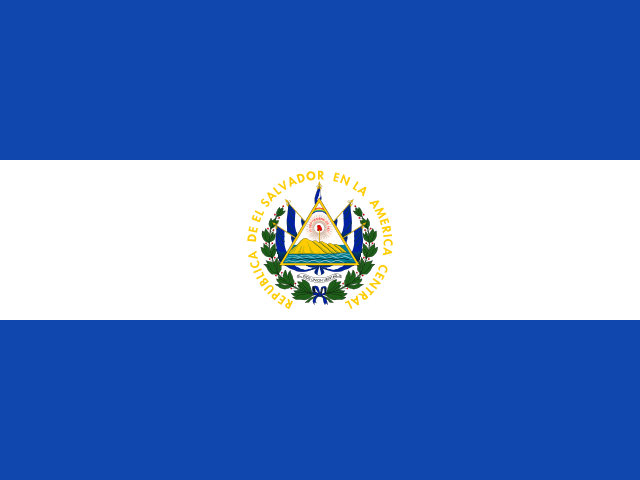
El Salvador
Population
Area
GDP
GDP Per Capita
Quick FAQs
Region
Capital
ISO 3166
Government Type
Language
ON THIS PAGE
About El Salvador
El Salvador is a country located in Central America, bordered by Guatemala, Honduras, and the Pacific Ocean, covering an area of approximately 21,041 square kilometers, making it the smallest country in Central America. As of 2025, El Salvador has a population of over 6.3 million, with Spanish as the official language. The country features coastal plains, central plateau, and volcanic mountain ranges, experiencing a tropical climate with distinct wet and dry seasons. San Salvador serves as the capital.
El Salvador’s economy is based on services, manufacturing, and remittances from citizens living abroad, which account for a significant portion of GDP. Key industries include textiles, food processing, and increasingly technology services. The country made international headlines by adopting Bitcoin as legal tender alongside the US dollar. El Salvador has experienced significant security improvements under recent government policies, though challenges including inequality, infrastructure gaps, and vulnerability to natural disasters remain. The country continues to develop its tourism and technology sectors.
Geography & Environment
Geographic Location
Geographic Coordinate
Geographic Area
Climate
Terrain
Natural Hazards
Natural Resources
Geography Note
People & Society
Ave. Life Expentancy at Birth
Urbanization
Population Growth Rate
Literacy Rate
Health Expendeture
Education Expenditure
Languages
Religions
Government
Country Name
conventional short form: El Salvador
local long form: República de El Salvador
local short form: El Salvador
etymology: means "the Savior" in Spanish and is a shortened form of "the Divine Savior of the World" (el Divino Salvador del Mundo), referring to Jesus Christ; 16th-century Spanish colonists gave the name "San Salvador" to the fort located where the country's capital of San Salvador now stands, and the name was later used for the city and the surrounding region; the country was officially named El Salvador in 1824
Economy
Economic Overview
upper-middle-income, dollarized Central American economy; reliant on remittances from US; recent growth linked to infrastructure investment, consumption, and crime reduction; $1.3 billion IMF loan to address fiscal imbalances; Bitcoin adopted as legal tender; persistent poverty and large informal sector